Digital marketing is evolving faster than ever. Businesses that rely only on traditional SEO, manual campaigns, and generic messaging are finding it harder to compete. Today, artificial intelligence is transforming how brands attract traffic, engage users, and convert visitors into loyal customers.
AI-powered digital marketing is no longer optional. It enables marketers to understand user intent, personalize experiences, automate workflows, and optimize performance with precision. This guide explains how AI reshapes digital marketing and how you can use it to improve visibility and conversions effectively.
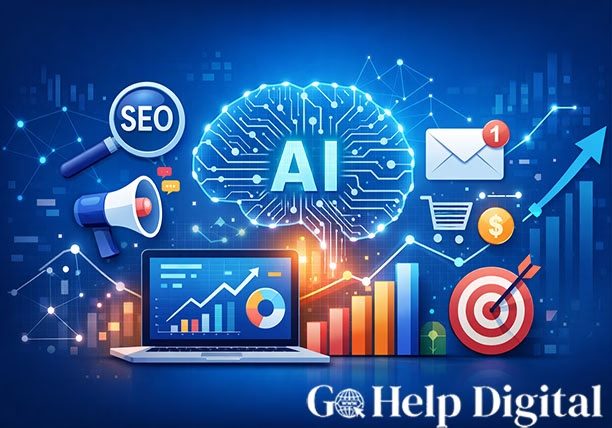
Why AI Is Transforming Digital Marketing
Artificial intelligence allows marketers to move from assumption-based strategies to data-driven decision-making. Instead of guessing what users want, AI analyzes behavior patterns, search intent, and engagement signals to guide marketing efforts.
How AI Changes Customer Behavior Analysis
AI processes massive volumes of user data in real time. It can analyze browsing behavior, purchase history, device usage, and interaction patterns to understand how customers think and act.
This allows marketers to:
Identify high-intent users
Predict buying behavior
Detect content gaps
Improve user journey mapping
Instead of static customer personas, AI enables dynamic audience profiling that evolves continuously.
From Traditional SEO to AI-Focused Optimization
Traditional SEO focused on keywords, backlinks, and rankings. AI-focused optimization goes deeper by understanding context, intent, and semantic meaning.
Modern AI search systems prioritize:
Helpful, complete answers
Natural language queries
Structured, well-organized content
Trustworthy and authoritative sources
Optimizing for AI means creating content that solves real problems, not just ranking for keywords.
AI-Powered Content Strategies That Drive Traffic
Content remains the foundation of digital marketing, but AI changes how content is researched, structured, and optimized.
Creating Search-Intent and AI-Ready Content
AI tools help identify what users are actually searching for—not just keywords, but questions, comparisons, and intent-driven queries.
Effective AI-ready content:
Answers specific questions clearly
Covers topics comprehensively
Uses conversational language
Includes summaries and step-by-step explanations
This improves both search visibility and engagement.
Optimizing Content for Answer Engines and Chatbots
Answer engines and AI chatbots pull direct responses from well-structured content. To optimize for them:
Use question-based headings
Add FAQ sections
Write concise answers followed by deeper explanations
Maintain clear formatting
When AI systems trust your content, your brand becomes a source of answers—not just links.
Using Structured Data for Better AI Visibility
Structured data helps search engines and AI tools understand your content better. Proper use of headings, lists, tables, and schema improves:
Featured snippet eligibility
Voice search visibility
AI-generated summaries
This boosts discoverability across multiple platforms.
Leveraging AI for Personalization and User Experience
Personalization is one of the strongest benefits of AI-powered digital marketing.
Behavior-Based Content Personalization
AI tracks how users interact with your site and adjusts content accordingly. This includes:
Personalized blog recommendations
Dynamic landing pages
Customized calls-to-action
Users see content that matches their interests, increasing engagement and time on site.
AI-Driven Email and Website Customization
AI optimizes email marketing by determining:
Best sending time
Subject line variations
Content relevance per user
On websites, AI can change banners, offers, and messaging based on user behavior, increasing conversion rates without manual intervention.
Improving Engagement Through Predictive Insights
Predictive analytics helps marketers anticipate user needs before they arise. AI can suggest:
When a user is likely to convert
Which content improves retention
Which products to recommend
This proactive approach improves user satisfaction and brand loyalty.
Automation and AI Tools for Smarter Marketing
AI-driven automation saves time while improving accuracy and consistency.
AI Tools for Content Research and Optimization
AI assists with:
Topic discovery
Content gap analysis
Keyword clustering
Readability improvements
This allows marketers to focus on strategy while AI handles repetitive research tasks.
Predictive Analytics for Better Decision-Making
AI analyzes historical data to predict future outcomes. Marketers can:
Forecast campaign performance
Allocate budgets efficiently
Reduce wasted ad spend
Predictive insights lead to smarter, faster decisions.
AI Chatbots for Lead Generation and Support
AI-powered chatbots engage users 24/7. They can:
Answer common questions
Qualify leads
Guide users to relevant pages
Improve customer support efficiency
This improves conversions while reducing operational costs.
Voice Search and Conversational Marketing
Voice search is growing rapidly, changing how users search for information.
Optimizing for Voice and Natural Language Queries
Voice searches are conversational and question-based. To optimize:
Use natural phrasing
Focus on long-tail queries
Provide clear, direct answers
This improves visibility in voice assistants and AI responses.
Conversational Content for AI Search Results
Content that sounds human performs better in AI-driven platforms. Writing in a conversational tone increases:
Trust
Readability
Engagement
This helps AI systems surface your content more frequently.
AI in Social Media and Performance Marketing
AI enhances both organic and paid social strategies.
AI-Driven Social Media Content Optimization
AI analyzes engagement patterns to determine:
Best posting times
Content formats that perform well
Audience preferences
This increases reach and interaction without trial-and-error.
Smarter Ad Targeting Using AI Algorithms
AI improves ad targeting by:
Identifying high-converting audiences
Optimizing bidding strategies
Adjusting creatives automatically
This leads to better ROI and lower acquisition costs.
Social Commerce and Short-Form Video Impact
AI helps brands combine entertainment with commerce. Short-form videos paired with smart recommendations drive impulse purchases and brand discovery.
Ethical AI and Data-Driven Marketing
Trust is critical in AI-powered marketing.
User Privacy and Responsible AI Usage
Marketers must:
Protect user data
Follow consent-based tracking
Avoid intrusive personalization
Responsible AI use builds long-term trust.
Building Trust with Transparent Data Practices
Transparency in data usage improves brand credibility. Users prefer brands that clearly explain how data is collected and used.
Measuring Success in AI-Driven Digital Marketing
Without measurement, optimization is impossible.
Key Metrics to Track Visibility and Conversions
Important KPIs include:
Organic traffic growth
Engagement metrics
Conversion rates
AI-driven referral traffic
Customer retention
These metrics show whether AI strategies are delivering results.
Using AI Analytics for Continuous Optimization
AI analytics platforms identify patterns humans might miss. Continuous optimization ensures campaigns improve over time instead of stagnating.
Final Thoughts on AI-Powered Digital Marketing
AI-powered digital marketing is about working smarter—not harder. By combining automation, personalization, predictive analytics, and ethical practices, businesses can significantly improve visibility and conversions.
How to Build a Future-Ready AI Marketing Strategy
To succeed:
Focus on user intent
Create high-value content
Structure content for AI visibility
Use automation wisely
Measure and refine continuously
Brands that embrace AI today will lead the digital landscape tomorrow.