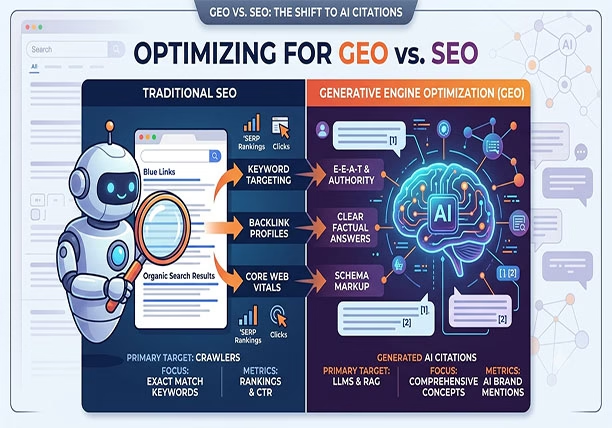
The e-commerce landscape is undergoing a massive shift. Online shoppers are no longer relying solely on standard search bar queries and ten blue links to discover products. Instead, consumers are turning to conversational AI assistants like ChatGPT, Google AI Overviews, Perplexity, and Claude to receive direct product recommendations, side-by-side feature comparisons, and tailored buying advice.
To stay competitive and capture traffic from next-generation AI models, online store owners must implement a dedicated AI Search Optimization Checklist for E-Commerce Websites. In this comprehensive guide, we will break down what AI search optimization entails for online stores, why structured product data matters more than ever, and provide an actionable, step-by-step checklist to ensure your catalog gets cited and recommended by leading generative search engines.
What is AI Search Optimization for E-Commerce?
AI search optimization (often referred to as Generative Engine Optimization or GEO for e-commerce) is the process of structuring, technical hardening, and content formatting designed to make product catalogs easily readable, verifiable, and digestible for Large Language Models (LLMs) and Retrieval-Augmented Generation (RAG) search pipelines.
When a customer asks an AI engine, “What are the best lightweight waterproof hiking boots under $150 for wide feet?”, the AI model does not simply match keywords. It queries live web data, evaluates structured product properties, synthesizes customer review sentiment, and presents curated recommendations with direct citation links.
Optimizing your e-commerce store for AI search ensures that your product inventory is indexed, understood, and recommended during these conversational buying journeys.
The Ultimate AI Search Optimization Checklist for E-Commerce Websites
Follow this step-by-step checklist to prepare your online store for generative AI discovery and conversational commerce:
Advanced Product Schema & Structured Data (JSON-LD)Natural Language FAQ & Buying Guide IntegrationGranular Product Attribute MappingUnstructured Customer Review & Sentiment OptimizationTechnical Accessibility for AI CrawlersReal-Time Price & Inventory Synchronization
1. Implement Comprehensive Product Schema & JSON-LD Structured Data
Machine readability is the single most important factor when optimizing for AI search engines. LLMs rely heavily on structured JSON-LD markup to extract exact specifications, pricing, availability, and offer terms without ambiguity.
Key Schema Requirements for E-Commerce:
ProductSchema: Define core properties includingname,image,description,sku,mpn,brand, andcategory.Offer/AggregateOfferSchema: Provide exactprice,priceCurrency,availability([https://schema.org/InStock](https://schema.org/InStock)), and price valid dates.AggregateRating&ReviewSchema: Explicitly structure overall review scores (ratingValue,reviewCount) alongside individual verified buyer reviews.MerchantReturnPolicy&ShippingDetailsSchema: Generative engines frequently factor return windows and delivery costs into shopping recommendations. Define your return policies and shipping thresholds explicitly in code.
2. Structure Product Pages with Natural Language Q&A Blocks
Generative AI models excel at matching complex, natural-language customer prompts with explicit answers. Traditional, brief bullet points are often insufficient for an LLM trying to evaluate subtle feature differences.
Optimization Strategies:
Frame Subheadings as Common Questions: Structure H2 and H3 tags on product pages as natural questions (e.g., “Is this jacket suitable for sub-zero temperatures?” or “How does sizing run for wide feet?”).
Provide Concise Direct Answer Paragraphs: Directly beneath each question, provide a clear 2-to-3 sentence answer before expanding into detailed specifications.
Build Dedicated Buying Guides: Create long-form category comparison guides that evaluate products based on specific use cases, body types, budget constraints, and technical requirements.
3. Map Granular Product Attributes and Specifications
AI search queries are highly specific. Users rarely ask for general categories; they specify attributes such as dimensions, material compositions, compatibility, battery life, weight, and environmental certifications.
Attribute Checklist:
Technical Specs Table: Convert unstructured product text into clean HTML
<table>elements detailing dimensions, materials, weight, wattage, and warranty info.Use-Case Tags: Explicitly state who the product is designed for and where it performs best (e.g., “Best for: Indoor plant setup, low-light environments”).
Compatibility Details: List exact model compatibility, software requirements, or hardware fit parameters.
4. Optimize Customer Review Sentiment & Unstructured Data
Retrieval-Augmented Generation (RAG) models analyze customer reviews to gauge real-world product performance, pros, cons, and reliability.
Tactics for Review Optimization:
Encourage Attribute-Specific Reviews: Prompts in post-purchase emails should ask customers specific questions regarding fit, durability, ease of use, and delivery speed.
Highlight Pros & Cons Summaries: Include structured bulleted summaries of verified customer feedback at the top of your review section.
Address Common Objections: Incorporate customer concerns directly into product FAQ sections to ensure AI models receive balanced, accurate information directly from your canonical source.
5. Ensure Technical Accessibility for AI Crawlers
An AI model cannot summarize or recommend products from pages it cannot crawl or parse efficiently.
Technical Checklist:
Check
robots.txtPermissions: Ensure major AI crawlers (such asGPTBot,PerplexityBot,ClaudeBot, andGoogle-Extended) are permitted to access your product catalog pages.Optimize Page Rendering & Load Speeds: Ensure product data and JSON-LD markup are rendered server-side or via clean hydrations so real-time RAG crawlers do not miss content due to delayed JavaScript execution.
Clean Sitemap Architecture: Maintain an updated XML product sitemap and submit it to search engine webmaster tools.
6. Maintain Real-Time Price & Inventory Accuracy
Recommending out-of-stock items or incorrect pricing damages the reliability of AI search tools. As a result, AI search pipelines prioritize stores that provide accurate, real-time inventory signals.
Use Merchant Center Data Feeds: Ensure your product feeds in Google Merchant Center and Bing Merchant Center are synced continuously.
Dynamic Stock Schema Updates: Automatically reflect
InStock,OutOfStock, orPreOrderstatus in your JSON-LD markup the moment inventory changes in your warehouse database.
Measuring AI Search Performance for E-Commerce
Tracking visibility in the era of generative AI requires looking beyond classic keyword rank trackers:
AI Engine Referral Traffic: Monitor Web Analytics for incoming traffic from domains like
chatgpt.com,perplexity.ai, andclaude.ai.Branded Search & Model Mentions: Test common conversational prompts inside AI assistants to verify whether your store is included in top recommendation citations.
Direct Citation Click-Throughs: Analyze traffic landing directly on specific product URLs originating from AI search references.