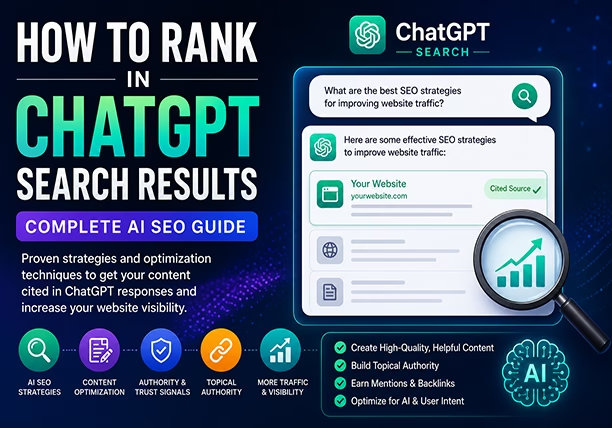
The search landscape is changing faster than ever. Google’s latest AI-powered search experience is transforming how users discover information online. This Google AI Mode SEO Guide will help website owners, bloggers, marketers, and businesses understand how AI-driven search works and how to optimize content for better visibility.
Traditional SEO focused on ranking web pages in search engine results pages (SERPs). However, with Google AI Mode, search results are becoming more conversational, personalized, and context-aware. Users can now receive direct answers generated by artificial intelligence, reducing the need to click multiple websites.
Understanding the new search ecosystem is crucial for maintaining and growing organic traffic. In this comprehensive Google AI Mode SEO Guide, you’ll learn ranking factors, optimization strategies, content creation techniques, and future-proof SEO practices that can help your website succeed.
What Is Google AI Mode?
Google AI Mode is an advanced search experience powered by generative artificial intelligence. Instead of simply displaying a list of blue links, Google uses AI to understand user intent and generate detailed responses directly within search results.
The technology combines:
- Large Language Models (LLMs)
- Knowledge Graph data
- Real-time web indexing
- User search context
- Machine learning algorithms
This creates more intelligent and conversational search experiences.
How Google AI Mode Works
When a user enters a query, Google AI Mode:
- Analyzes search intent.
- Identifies authoritative sources.
- Synthesizes information from multiple pages.
- Generates AI-powered responses.
- Provides supporting citations and links.
The goal is to deliver comprehensive answers while still directing users to trustworthy sources.
Why Google AI Mode Matters for SEO
The introduction of AI-powered search is one of the biggest changes in SEO history.
Key Impacts on Website Traffic
Reduced Click-Through Rates
Many informational queries are answered directly in search results, reducing clicks to websites.
Increased Importance of Authority
Google increasingly prioritizes trustworthy and expert content.
Greater Focus on Content Quality
Thin content and keyword stuffing are becoming ineffective.
New Ranking Opportunities
Well-optimized websites can become cited sources within AI-generated answers.
Google AI Mode Ranking Factors
While Google has not disclosed every ranking signal, several factors appear to influence AI search visibility.
Content Relevance
Your content must directly answer user questions.
Best practices include:
- Answering questions clearly.
- Using simple language.
- Structuring content logically.
- Covering topics comprehensively.
Topical Authority
Google prefers websites that consistently publish content around a specific niche.
Example
A website publishing 100 high-quality SEO articles will generally outperform a website publishing random content across unrelated topics.
Experience, Expertise, Authoritativeness, and Trustworthiness (E-E-A-T)
Google heavily evaluates:
- Real-world experience
- Industry expertise
- Brand authority
- User trust signals
Adding author profiles, case studies, testimonials, and references strengthens E-E-A-T.
User Experience Signals
Google AI Mode favors websites that provide excellent user experiences.
Factors include:
- Mobile responsiveness
- Fast loading speed
- Easy navigation
- Secure HTTPS connection
Content Optimization for Google AI Mode
Creating AI-friendly content requires a strategic approach.
Answer Questions Directly
AI systems prefer content that provides immediate answers.
Example
Question:
“What is Google AI Mode?”
Good Answer:
“Google AI Mode is an AI-powered search experience that generates conversational responses using information from trusted web sources.”
Use Clear Headings
Well-structured content helps AI understand page hierarchy.
Use:
- H2 for major topics
- H3 for subtopics
- H4 for detailed explanations
Create Comprehensive Content
Cover topics thoroughly rather than targeting a single keyword repeatedly.
Include:
- Definitions
- Examples
- FAQs
- Benefits
- Challenges
- Best practices
Add Original Insights
Unique perspectives improve content quality.
Examples include:
- Personal experiences
- Industry observations
- Case studies
- Research findings
Keyword Strategy for AI Search
Traditional keyword targeting is evolving.
Focus on Search Intent
Understand what users actually want.
Informational Intent
Users seek knowledge.
Example:
“How does Google AI Mode work?”
Commercial Intent
Users compare products or services.
Example:
Transactional Intent
Users want to take action.
Example:
“Buy SEO software.”
Target Long-Tail Keywords
Long-tail keywords align closely with conversational searches.
Examples:
- Google AI Mode SEO Guide
- How to optimize content for AI search
- AI search ranking factors
- Google AI search optimization tips
Technical SEO for Google AI Mode
Technical optimization remains important.
Improve Website Speed
Fast websites improve user experience and search visibility.
Recommended actions:
- Compress images
- Enable caching
- Use a CDN
- Minimize code
Optimize Structured Data
Schema markup helps search engines understand content.
Useful schema types:
- Article
- FAQ
- Organization
- Product
- Review
Ensure Mobile Optimization
Most searches occur on mobile devices.
Check:
- Responsive design
- Touch-friendly navigation
- Readable fonts
- Mobile loading speed
The Role of E-E-A-T in AI Search
E-E-A-T has become more important than ever.
Experience
Show firsthand knowledge.
Examples:
- Case studies
- Tutorials
- Personal testing
Expertise
Demonstrate professional knowledge.
Ways to establish expertise:
- Author bios
- Certifications
- Industry credentials
Authoritativeness
Build recognition within your niche.
Methods include:
- Guest posting
- Industry mentions
- Backlinks
Trustworthiness
Improve credibility through:
- Contact information
- Privacy policies
- Secure websites
- Accurate information
Common SEO Mistakes to Avoid
Many websites struggle because they continue using outdated strategies.
Keyword Stuffing
Repeating keywords excessively harms readability.
Thin Content
Short, low-value articles rarely perform well.
Ignoring User Intent
Ranking becomes difficult when content fails to satisfy user needs.
Publishing AI-Generated Content Without Editing
AI can assist content creation, but human review remains essential.
How to Increase Visibility in AI Search Results
Build Topic Clusters
Create interconnected content around a central topic.
Example SEO cluster:
- SEO Basics
- Technical SEO
- Local SEO
- AI SEO
- Link Building
- SEO Tools
Update Existing Content
Fresh content often performs better.
Review articles regularly and update:
- Statistics
- Examples
- Screenshots
- Best practices
Earn High-Quality Backlinks
Backlinks remain an important trust signal.
Focus on:
- Industry websites
- Relevant blogs
- News publications
Create FAQ Sections
AI systems frequently extract answers from FAQs.
Example FAQ
Is Google AI Mode replacing traditional search?
No. Google AI Mode enhances traditional search by providing AI-generated responses while still linking to web pages.
Does SEO still matter in AI search?
Yes. SEO remains essential because AI systems rely on high-quality content from websites.
Future of SEO in the AI Era
The future of SEO is shifting from simple keyword optimization to user-focused content creation.
Successful websites will:
- Demonstrate expertise
- Build trust
- Publish original insights
- Optimize technical performance
- Focus on user intent
AI search rewards quality over quantity. Businesses that adapt early will gain a competitive advantage.
Final Thoughts
Google’s AI-powered search experience is reshaping digital marketing. This Google AI Mode SEO Guide highlights the importance of creating valuable, authoritative, and user-focused content that satisfies search intent.
While AI search may reduce clicks for some queries, it also creates new opportunities for websites to become trusted information sources. By focusing on E-E-A-T, technical SEO, comprehensive content, and user experience, businesses can thrive in the evolving search ecosystem.
The future of SEO belongs to websites that provide genuine value. Start optimizing for AI search today, and you’ll be better positioned to capture organic traffic in 2026 and beyond.