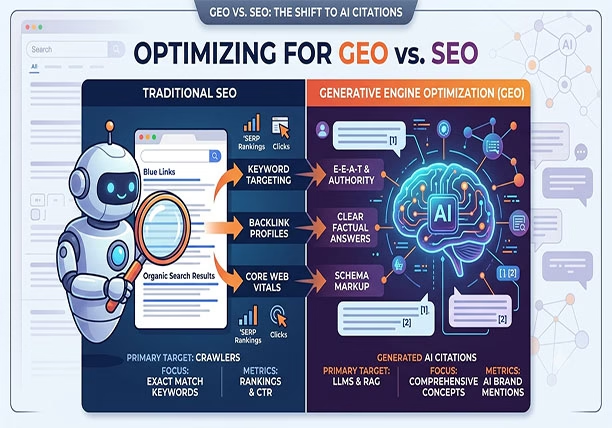
This AI-Powered Keyword Research Guide explains how artificial intelligence is transforming keyword discovery, search intent analysis, and content planning. Whether you are a blogger, marketer, or business owner, learning AI-powered keyword research can help you find low-competition keywords faster and grow organic traffic more effectively.
Keyword research has always been the foundation of successful SEO. Whether you run a blog, an eCommerce store, a service-based business, or an affiliate website, your ability to identify the right keywords directly impacts your organic traffic and online visibility. However, traditional keyword research methods often require hours of manual analysis, spreadsheet management, and competitive research.
Artificial intelligence is changing this process dramatically. Modern AI tools can analyze search trends, discover hidden opportunities, understand search intent, and generate hundreds of keyword ideas within minutes. As search engines become smarter and AI-powered search platforms such as ChatGPT, Gemini, and Perplexity gain popularity, marketers must adapt their keyword research strategies to remain competitive.
Why This AI-Powered Keyword Research Guide Matters
Some marketers believe keyword research is becoming less important because search engines now understand context and user intent better than ever before. While search algorithms have evolved significantly, keyword research remains one of the most important aspects of SEO.
Keywords help search engines understand what your content is about. More importantly, they reveal what users are actively searching for online. Every search query represents a problem, question, need, or interest. When your content aligns with those searches, you have an opportunity to attract targeted visitors.
The difference today is that keyword research is no longer just about finding phrases with high search volume. Modern SEO requires understanding intent, topical relevance, user behavior, and semantic relationships between topics. This is where artificial intelligence becomes incredibly valuable.
Instead of simply generating keyword lists, AI helps marketers understand why people search, what information they expect to find, and how related topics connect together.
How AI Is Transforming Keyword Research
Artificial intelligence has fundamentally changed how marketers approach SEO. Traditional keyword research often involved entering a seed keyword into a tool and reviewing hundreds of suggestions manually. This process could take hours and still miss valuable opportunities.
AI dramatically accelerates this process by analyzing large datasets and identifying patterns that would be difficult for humans to discover.
Understanding Search Intent More Accurately
One of the biggest advantages of AI is its ability to interpret search intent.
For example, the keyword “best laptops” suggests a user is comparing products. Meanwhile, “how to speed up a laptop” indicates informational intent.
Although both keywords involve laptops, they require entirely different content strategies.
AI tools can categorize keywords automatically into informational, commercial, navigational, and transactional groups. This helps content creators develop articles that align more closely with user expectations.
Why Search Intent Matters
Google increasingly prioritizes content that satisfies user intent rather than content that simply contains keywords.
If someone searches for “how to start a blog,” they want guidance and instructions. Showing them a sales page for blogging software would not satisfy their needs.
AI helps marketers identify these distinctions early in the keyword research process.
Discovering Hidden Keyword Opportunities
One of the most powerful features of AI-driven tools is their ability to uncover keyword opportunities that competitors may overlook.
Traditional tools often focus on obvious keywords with established search volume. AI systems can identify related questions, conversational phrases, and emerging trends that have not yet become highly competitive.
For example, instead of targeting a broad keyword like:
AI may reveal opportunities such as:
- Best AI SEO tools for bloggers
- SEO tools for small businesses
- Free AI SEO tools for content creators
- AI keyword research tools for beginners
These longer phrases often have lower competition and higher conversion potential.
Benefits of an AI-Powered Keyword Research Guide
Faster Research Process
AI dramatically reduces the time required to identify opportunities.
Tasks that previously took several hours can often be completed in minutes.
This allows marketers to focus more on content creation and strategy instead of data collection.
Better Topic Clustering
Modern SEO increasingly relies on topical authority.
Rather than publishing isolated articles, websites benefit from creating clusters of related content.
AI can automatically identify supporting topics, subtopics, and related questions that strengthen content clusters.
For example, if your main topic is AI SEO, AI tools may recommend related content covering:
- AI search optimization
- ChatGPT SEO
- Gemini SEO
- GEO strategies
- AI content creation
This creates a stronger topical foundation.
Improved Content Planning
AI can analyze competitors, search trends, and user behavior to suggest content opportunities that align with audience interests.
This helps eliminate guesswork from content planning.
Tools Used in AI-Powered Keyword Research Guide
The market now offers numerous AI-powered SEO tools, each with unique strengths.
ChatGPT
ChatGPT has become one of the most popular tools for brainstorming keyword ideas.
Although it does not provide search volume data directly, it excels at:
- Generating content ideas
- Discovering long-tail keywords
- Creating topic clusters
- Identifying user questions
For example, asking ChatGPT:
“Generate 50 long-tail keywords related to AI SEO.”
can instantly produce valuable keyword ideas.
Best Use Cases
- Blog topic generation
- Keyword brainstorming
- FAQ discovery
- Content clustering
Semrush
Semrush combines traditional SEO data with AI-powered insights.
It provides:
- Keyword difficulty
- Search volume
- Competitive analysis
- Topic recommendations
Many professional marketers rely on Semrush for large-scale keyword research campaigns.
Ahrefs
Ahrefs remains one of the most powerful SEO research platforms.
Its AI-enhanced features help marketers discover:
- Keyword opportunities
- Content gaps
- Competitor weaknesses
- Link-building opportunities
The platform is particularly useful for identifying low-competition keywords.
Surfer SEO
Surfer SEO uses AI to analyze ranking pages and recommend optimization opportunities.
It helps marketers understand:
- Content structure
- Keyword usage
- Topic coverage
- Competitive benchmarks
Step-by-Step AI-Powered Keyword Research Process
Step 1: Start with a Seed Topic
Every keyword research project begins with a core topic.
Examples include:
- SEO
- Digital marketing
- Blogging
- AI tools
- Content marketing
Choose topics closely aligned with your business goals.
Step 2: Generate Keyword Ideas Using AI
Use AI tools to expand your seed topic into dozens or hundreds of keyword possibilities.
Instead of targeting broad terms only, focus on specific questions and long-tail variations.
For example:
Seed Topic:
SEO
AI Suggestions:
- SEO for beginners
- AI SEO strategies
- Local SEO guide
- Technical SEO checklist
- SEO content optimization
Step 3: Analyze Search Intent
Categorize keywords based on user goals.
Informational
Users seek knowledge.
Example:
“What is AI SEO?”
Commercial
Users compare options.
Example:
“Best AI SEO tools.”
Transactional
Users intend to purchase.
Example:
Matching content to intent improves ranking potential.
Step 4: Evaluate Competition
One common mistake is targeting highly competitive keywords too early.
New websites should prioritize low-competition opportunities.
AI tools help identify:
- Keyword difficulty
- Competitor strength
- Ranking feasibility
A keyword with lower competition often produces faster results.
Step 5: Build Topic Clusters
Instead of publishing unrelated content, create structured topic clusters.
Example AI SEO Cluster
Pillar Article
AI-Powered Keyword Research Guide
Supporting Articles
- Best AI SEO Tools
- AI Search Optimization
- ChatGPT SEO Strategies
- Keyword Clustering Guide
- GEO Best Practices
This structure strengthens topical authority.
Using AI for Long-Tail Keyword Discovery
Long-tail keywords are often overlooked despite their significant value.
They typically have:
- Lower competition
- Higher relevance
- Better conversion rates
For example:
Instead of:
SEO
Target:
- SEO strategies for small businesses
- SEO checklist for bloggers
- AI-powered SEO tools for beginners
AI excels at generating these opportunities.
AI and Semantic SEO
Search engines increasingly rely on semantic understanding.
This means they analyze relationships between topics rather than individual keywords.
AI helps identify related concepts and supporting topics that improve content depth.
For example, an article about SEO may naturally include:
- Keywords
- Backlinks
- Search intent
- Content marketing
- Technical SEO
Covering these related topics improves topical relevance.
Common AI Keyword Research Mistakes
While AI offers significant advantages, marketers should avoid several common mistakes.
Relying Entirely on AI
AI should assist decision-making rather than replace human judgment.
Always review keyword suggestions carefully.
Ignoring Search Intent
A keyword may have high volume but low relevance to your audience.
Intent remains critical.
Targeting Only High-Volume Keywords
High search volume often means high competition.
Long-tail opportunities frequently provide better ROI.
Skipping Competitor Analysis
Understanding competitor strengths remains essential.
AI should complement competitive research rather than replace it.
Future of AI-Powered Keyword Research
The future of keyword research will be increasingly driven by artificial intelligence.
We can expect AI systems to become better at:
- Predicting trends
- Understanding user behavior
- Identifying content gaps
- Generating topic clusters
- Analyzing intent
As AI search platforms continue to grow, keyword research will evolve beyond individual terms and focus more on topics, entities, and user needs.
Successful marketers will use AI not simply to find keywords but to understand audiences more deeply.
Frequently Asked Questions
What is AI-powered keyword research?
AI-powered keyword research uses artificial intelligence tools to discover keyword opportunities, analyze search intent, identify trends, and improve SEO strategies.
Is AI keyword research better than traditional keyword research?
AI significantly improves efficiency and insight, but the best results come from combining AI analysis with human expertise.
Can ChatGPT perform keyword research?
Yes. ChatGPT is excellent for brainstorming keyword ideas, topic clusters, FAQs, and content planning.
Which AI tool is best for keyword research?
Popular options include ChatGPT, Semrush, Ahrefs, Surfer SEO, and Keyword Insights.
Are long-tail keywords still effective?
Absolutely. Long-tail keywords often have lower competition and higher conversion rates than broad keywords.
Conclusion
This AI-Powered Keyword Research Guide demonstrates how artificial intelligence is transforming one of the most important aspects of SEO. Instead of spending countless hours manually researching keywords, marketers can now use AI to uncover opportunities, understand search intent, build topic clusters, and create more effective content strategies.
The most successful SEO campaigns are no longer built solely on search volume metrics. They are built on understanding users, solving problems, and creating comprehensive content that satisfies intent. AI makes this process faster, smarter, and more scalable.
By combining AI-powered tools with sound SEO fundamentals, businesses can discover low-competition keywords, increase organic visibility, and build sustainable traffic growth. As search continues to evolve, those who embrace AI-driven keyword research will be better positioned to compete, adapt, and succeed in the future of digital marketing.