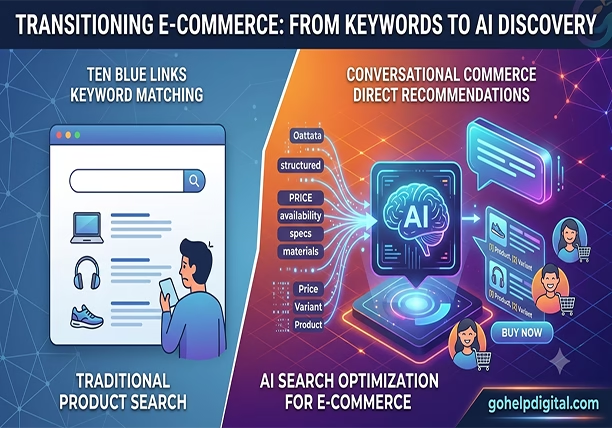
Think about the last time you researched a new software tool, a service provider, or a major purchase. Instead of opening ten browser tabs and scanning through pages of blue links, there is a good chance you asked an AI assistant like ChatGPT, Gemini, Perplexity, or Google’s AI Mode for a recommendation.
Your customers are doing the exact same thing.
This shift changes the rules of brand discovery. In traditional search, ranking on the first page—even in the fifth or sixth spot—still gave your business a fighting chance to earn a click. In AI-generated answers, there is no page two. The model acts like a trusted advisor, weighing the information available across the web and delivering a synthesized shortlist of just two or three options. Either your brand is part of that recommendation, or it is left out of the conversation entirely.
Yet most businesses still have no idea how AI models describe them, which competitors they get compared against, or whether the pricing and product details being shared are even accurate. Understanding and managing how artificial intelligence talks about your brand has quickly become one of the most important priorities in modern marketing.
Why AI Brand Perception Matters More Than Ever
For years, digital marketing followed a straightforward path: create content around target keywords, earn backlinks, climb the search rankings, and capture website traffic. Today, large language models (LLMs) and AI answer engines sit directly between your business and your potential buyers, shaping opinions before anyone ever visits your homepage.
Research on generative search shows just how concentrated and influential these answers have become:
AI answers reward a small circle of leaders: Industry studies reveal that in many sectors, the top two brands capture half or more of all AI brand mentions, leaving dozens of competitors fighting over tiny fractions of visibility.
Unbranded discovery is the real battleground: When users explicitly type your brand name into a prompt, AI models usually recognize you. However, when buyers ask open-ended category questions—such as “What is the best platform for…” or “Who are the top providers of…”—inclusion rates drop dramatically unless your brand has strong, clear authority across the web.
AI-referred visitors convert at higher rates: Because AI assistants help buyers narrow down their choices during the research phase, prospects who eventually click through from an AI recommendation arrive with higher intent and convert significantly better than casual search browsers.
Zero-click decisions are rising: Roughly two-thirds of searches now end without a click to a traditional website. Buyers read the AI summary, form an impression of your brand, and make decisions right inside the chat interface.
If an AI engine paints your brand as outdated, overly expensive, or suited only for a narrow niche, you lose the customer before your sales team or website ever gets a chance to make a pitch.
Why Your Current SEO Dashboard Only Tells Half the Story
Many marketing teams assume that strong traditional SEO automatically translates into strong AI visibility. While good SEO foundations help, relying strictly on keyword rankings and organic click metrics leaves dangerous blind spots:
1. Different AI Engines Rely on Different Sources
Visibility is no longer uniform across platforms. One AI assistant might pull heavily from recent editorial articles and industry roundups, while another leans toward structured product databases, review platforms, or community discussions. Overlapping citation sources between platforms like ChatGPT and Perplexity can be surprisingly low, meaning a brand that looks dominant on one assistant might barely appear on another.
2. Brand Mentions and Website Citations Are Separate Metrics
In traditional search, showing up meant getting a link. In AI search, a model can recommend your brand by name without linking to your website, or it can cite one of your educational blog posts as a source without recommending your product. Tracking organic referral traffic alone misses every conversation where an AI assistant talks about your brand without sending a click.
3. Third-Party Sites Often Control Your Narrative
Even when an AI model recommends your company, it rarely relies on your corporate website alone. Broad audits of AI citations show that the vast majority of sources models pull from are external—earned media, review aggregators, comparison blogs, and industry directories. If a third-party review site has outdated pricing or an old product description, AI engines will repeat those inaccuracies as fact.
The Risks of Leaving Your AI Narrative Unmonitored
When you do not actively monitor how generative engines represent your business, three common problems tend to creep in:
Outdated Pricing and Feature Hallucinations: AI models synthesize data from multiple sources over time. If your current pricing, service tiers, or product capabilities are buried in PDFs or unclear marketing copy, models will fill in the blanks using old blog posts or third-party guesses.
Competitor Misalignment: Without clear positioning, AI assistants may group you with the wrong tier of competitors—comparing an enterprise solution against budget tools, or framing a specialized service as a generic alternative.
Inaccurate Support and Policy Details: Customers increasingly ask AI assistants practical questions about refund policies, cancellation steps, and customer support channels. When official policy pages are hard to parse, models can surface wrong instructions or even route users toward lookalike third-party sites.
How to Audit How AI Is Talking About Your Brand
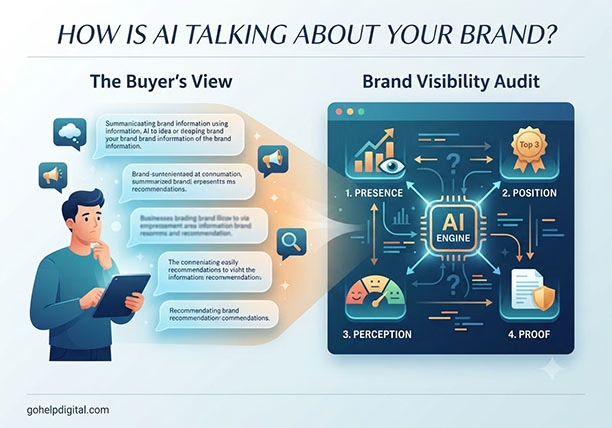
You do not need an enterprise software suite to start understanding your AI footprint. You can run a structured baseline audit by evaluating your brand across four core pillars: Presence, Position, Perception, and Proof.
| Audit Pillar | Key Question to Ask | What to Look For |
| 1. Presence | Does AI mention us when buyers do not use our name? | Whether your brand appears in general category, problem-solving, and “best of” prompts. |
| 2. Position | Where do we sit in the recommendation order? | Are you listed as the top choice, a runner-up, or an afterthought—and which competitors appear beside you? |
| 3. Perception | Is the description accurate and favorable? | The tone used to describe you, key strengths highlighted, weaknesses noted, and accuracy of facts. |
| 4. Proof | Which sources is the AI citing to back up its claims? | Whether links point to your own website or to external reviews, news articles, and directories. |
Running a Practical Prompt Test
To get an honest picture of your visibility, test a set of 20 to 30 realistic buyer prompts across major platforms (such as ChatGPT, Gemini, Perplexity, and Google AI Overviews) using fresh, logged-out sessions so your personal search history does not skew the results:
Category Discovery Prompts: “What are the top [your category] companies for [target audience]?”
Problem-Solution Prompts: “How can a [type of business] solve [specific pain point]?”
Head-to-Head Comparison Prompts: “[Your Brand] vs. [Main Competitor]: which is better?”
Trust and Policy Prompts: “Is [Your Brand] reliable? What is their pricing and refund policy?”
Document the exact wording used to describe your company, every competitor mentioned alongside you, and every URL listed in the citations.
Six Practical Ways to Improve Your AI Brand Visibility
Once you see where the gaps are, you can take deliberate steps to help AI engines understand, trust, and recommend your brand. In the industry, this practice is often called Generative Engine Optimization (GEO) or Answer Engine Optimization (AEO).
1. Build Clear, Structured “Source-of-Truth” Pages
AI models extract facts most reliably from clean, straightforward writing. Avoid hiding crucial information inside downloadable PDFs, complex graphics, or vague buzzwords. Create dedicated, easy-to-read web pages for your core offerings, pricing tiers, specifications, integrations, and policies. Use clear headings, bullet points, comparison tables, and direct FAQ sections so both human readers and AI crawlers can immediately verify the facts.
2. Define Your Brand Identity Consistently Everywhere
Make it unmistakable who you are, what category you belong to, and who you serve. Your homepage, “About” page, and structured data markup (Organization, Product, and FAQPage schema) should state your core value proposition in plain language. Keep your company description, naming, and category tags consistent across your website, LinkedIn, industry directories, and review profiles so AI models can connect the dots with confidence.
3. Strengthen Your Third-Party Footprint
Because AI engines lean heavily on external validation, off-site credibility directly drives on-site recommendations. Look at the exact review sites, directories, and industry publications that appeared in your audit citations. Claim and update your profiles on those platforms, encourage authentic customer reviews, and pursue digital PR placements or guest contributions in respected trade publications that generative engines already treat as authoritative sources.
4. Publish Honest Comparison and Buyer Guides
High-intent buyers frequently ask AI assistants to compare specific brands or explain how to choose a vendor. Instead of avoiding competitor comparisons, publish fair, objective comparison pages (“[Your Brand] vs. [Competitor]”) and practical buying guides. Clearly explain where your product shines—and even note scenarios where a different approach makes sense. Generative models favor balanced, informative content and frequently adopt clear comparison frameworks directly into their summaries.
5. Keep Content Fresh and Data-Backed
AI search systems show a strong preference for up-to-date information supported by concrete details, original research, and clear examples. Regularly refresh your cornerstone guides, product pages, and statistics so models do not treat your site as stale. Placing clear, direct answers near the top of your articles also increases the likelihood that an engine will pull your explanation into its response.
6. Check Your Technical Access for AI Crawlers
Even the best content cannot help you if AI search bots are blocked from reading it. Review your website’s robots.txt file and security settings to ensure you are not unintentionally blocking legitimate search and answer-engine crawlers (such as OAI-SearchBot or PerplexityBot) from indexing your public product, pricing, and educational pages.
Moving From Passive Observation to Active Brand Stewardship
Generative AI has fundamentally changed how people discover, evaluate, and trust businesses. The companies that thrive in this environment are not necessarily the ones with the loudest advertising—they are the ones that make their expertise, positioning, and facts effortless for both people and AI systems to verify.
By auditing how AI engines currently describe your brand, cleaning up outdated third-party profiles, and publishing clear, structured answers to your customers’ most important questions, you turn AI search from an unpredictable black box into a reliable growth channel.